In Nerve Hearing Impairment the Problem Lies in
Hearing loss is the result of sound signals not reaching the brain. Auditory neuropathy is a rare type of hearing loss.
Auditory System Psychology
And conductive hearing loss when sounds are unable to pass from the outer ear to the inner ear.
. According to E Medicine Health auditory neuropathy involves the nerve that carries signals from the inner ear to the brain and is responsible for hearing. Excessive noise can damage the ending of the nerve which causes permanent hearing loss or tinnitus. A myelinated nerve fiber is _____ whereas an unmyelinated nerve fiber is _____.
The most common type of permanent hearing loss it cannot be medically or surgically corrected as conductive hearing loss often is. SNHL accounts for about 90 of reported hearing loss citation needed. It is the cause of more than 90 percent of hearing loss in adults.
Auditory neuropathy is sometimes referred to as a form of neural or nerve deafness. An impulse from one nerve cell is communicated to another nerve cell via the _____. Most of the time medicine or surgery cannot.
A person with a conductive hearing loss may hear better in noise than. This kind of impairment cannot be helped with ordinary hearing aids gate control theory. Soft sounds may be hard to hear.
Conductive hearing loss can be caused by blockage of the external canal perforation of the eardrum infections and diseases of the middle ear and disruption or fixation of the small hearing bones. Some have argued that the problem lies mainly with the stria vascularis a sort of battery in the inner ear that powers the transformation of sound energy into nerve impulses. Conduction hearing impairment refers to hearing problems that originate in the _____.
Both ears are usually affected and the hearing loss ranges from mild to severe. The configuration or shape of the hearing loss refers to the pattern of hearing loss across frequencies as illustrated in a graph called an audiogramFor example flat hearing loss configurations indicate approximately the same amount of hearing loss for low and high frequencies whereas the configuration for a high-frequency or a low-frequency loss will appear. There are two main types of hearing loss depending on where the problem lies.
Injury to these nerves can. When the nerves of the inner ear are affected more on one side than the other according to Neurologist Calise in Fort Lauderdale he explained that this can cause a sensation of spinning or dizziness. The 12 pairs of cranial nerves that emerge from the brain provide motor and sensory nerves to the head and neck.
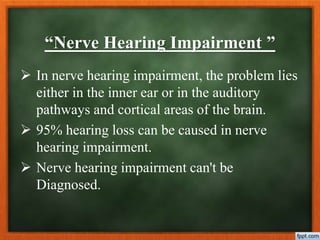
Sensorineural hearing loss is caused by damage to the sensitive hair cells inside the inner ear or damage to the auditory nerve. Comprehending speech is a complex task. Chapter 3 page 95 In nerve hearing impairment the problem lies either in the inner ear or in the auditory pathways and cortical areas of the brain.
Sensorineural hearing loss or nerve hearing loss occurs when the inner ear or the pathways from the inner ear to the brain have been damaged. For more information visit the National Institute of. Cranial nerve injuries are common complications of traumatic brain injury due to trauma or other conditions.
Sometimes the hearing loss is caused by damage to the nerve that carries the signals to the brain. But a new study places the blame largely with hair cells -- the. SNHL is usually permanent and can be mild moderate severe profound or total.
In every individual there are approximately 4000050000 hearing hair cells within the cochlea the hearing mechanism. In central hearing loss the problem lies in the central nervous system at some point within the brain. Neural hearing loss is the correct term to use when the damage is to the auditory nerve anywhere between its fibers at the base of the hair cells and the relay stations in the brain.
Even louder sounds may be unclear or may sound muffled. Sensorineural hearing loss SNHL is caused by damage to these special cells or to the nerve fibers in the inner ear. Although disablement must be caused by a physical or mental health.
Sensorineural hearing loss caused by damage to the sensitive hair cells inside the inner ear or damage to the auditory nerve. Nerve hearing impairment the problem lies either in the inner ear or in the auditory pathways and cortical areas of the brain. It is an otologic.
Central hearing loss. Improve Hearing Loss due to Nerve Damage. Aging and exposure to loud noise may cause wear and tear on the hairs or nerve cells in the cochlea that send sound signals to the brain.
Sensorineural hearing loss or SNHL happens after inner ear damage. Sensorineural deafness that is present at birth congenital is most often due to. An impulse from one nerve cell is communicated to another nerve cell via the.
This is the most common type of permanent hearing loss. Sensorineural hearing loss SNHL is a type of hearing loss in which the root cause lies in the inner ear or sensory organ cochlea and associated structures or the vestibulocochlear nerve cranial nerve VIII. The term nerve damage refers to sensorineural hearing loss or permanent hearing loss which may have resulted from noise exposure head trauma surgery or aging.
Injury of the nerves that affect the eyes and ears can cause dysfunction in vision and hearing. Damage to the inner ear. In most instances patients with nerve damage still have 10000 20000.
It is caused by disruption of the nerve impulses travelling from the inner ear to the brain although what causes this is unknown and there is no cure. Problems with the nerve pathways from your inner ear to your brain can also cause SNHL. Sudden sensorineural hearing lossSSHL is medicinally treated with corticosteroids.
Tumors in the brain can damage the acoustic nerve which is called Acoustic neuroma. Auditory Neuropathy Spectrum Disorder Hearing loss that occurs when sound enters the ear normally but because of damage to the inner ear or the hearing nerve sound isnt organized in a way that the brain can understand. Sensorineural hearing loss involves problems with the inner ear and hearing nerve.
Nerve hearing loss is often associated with aging but may also result from head trauma a virus or. Hearing loss that includes both a conductive and a sensorineural hearing loss. There are two main types of hearing loss depending on where the problem lies.
Sensorineural hearing loss SNHL is caused by damage to the structures in your inner ear or your auditory nerve. When these hairs or nerve cells are damaged or missing electrical signals arent transmitted as efficiently and hearing loss occurs. This occurs naturally with age or as a result of injury.

About Hearing Loss Carolina Audiology Associates
Auditory System Psychology

Types Of Hearing Loss Degrees Of Hearing Loss New Jersey

Comments
Post a Comment